SD2112 / WEEK 11
Whose design?
Who chooses? Who gets credit? Who is responsible?
SD2112 / WEEK 11
Whose design?
Who chooses? Who gets credit? Who is responsible?
NEWS / 12 NOVEMBER 2026 / US MARKET CLOSE
AI markets are unsettled.
NVIDIA
-4.3%
Share price
NASDAQ
-0.39%
Stock index
AMD
+5.9%
Share price
BROADCOM
+5.5%
Share price
One trading day. Different directions. Not proof that all AI businesses are collapsing.
SD2112 · AI IN DESIGN · WEEK 11
02
NEWS / NVIDIA ANNOUNCEMENT / 12 NOVEMBER 2026
Jensen Huang steps down.
WHAT CHANGED
Huang resigned.
He left the president, CEO and board roles, effective immediately.
→
WHO LEADS NOW
Colette Kress.
The CFO becomes interim CEO while also remaining CFO.
→
WHAT IS NEXT
A successor search.
The board will consider internal and external candidates.
The announcement says resignation, not retirement. Future retirement plans are not confirmed.
SD2112 · AI IN DESIGN · WEEK 11
03
OPENING QUESTION / THINK, THEN DISCUSS
If AI makes the work,
what makes it yours?
SD2112 · AI IN DESIGN · WEEK 11
04
TOPIC 1 / 4
Mediation
How does AI shape what we understand?
SD2112 · AI IN DESIGN · WEEK 11
05
FICTIONAL EXAMPLE / AN AI MUSEUM GUIDE
Which story does the guide tell?
MUSEUM
Facts about the boat.
An old fishing boat is on display. The museum label says when it was built.
FISHING FAMILY
Life on the boat.
The family could explain what it was like to work on the boat.
IF NO ONE HAS ASKED
Say what is missing.
The guide should say the family has not been interviewed. It must not invent their story.
SD2112 · AI IN DESIGN · WEEK 11
06
MEDIATION / VERBEEK 2015
The tool frames what we notice.
01 / SOURCE
The museum gives facts.
The label says when the fishing boat was built.
→
02 / TOOL FRAMING
The guide summarises.
It tells the museum story, but leaves out the fishing family.
→
03 / VISITOR
The visitor reads one story.
They may learn when it was built, but miss what life on the boat was like.
The guide shapes how we understand the boat. It does not just pass on facts.
SD2112 · AI IN DESIGN · WEEK 11
07
TOPIC 2 / 4
Curation and power
Who chooses what we see?
SD2112 · AI IN DESIGN · WEEK 11
08
CURATION / CHOICE HAS POWER
Choosing one story leaves another out.
INCLUDED / VISIBLE
The museum story.
Facts about the boat are easy to find. The team puts them first.
→
EDITORIAL CHOICE
What appears first?
The team decides which sources and stories the guide uses.
→
EXCLUDED / MISSING
The family story.
If no one has asked the fishing family, say so. Do not invent their story.
Choosing what to show also means choosing what people will not see.
SD2112 · AI IN DESIGN · WEEK 11
09
THE STUDY / D
Write a story. Change the starting help.
WHAT THEY DID
293 UK writers produced an eight-sentence story for young readers. Random assignment: no AI ideas, access to one, or up to five GPT-4 starting ideas.
WHAT THEY COMPARED
Writers wrote their own story. 600 separate evaluators each rated six stories before learning about AI access.
SOURCE ADAPTATION / METHODS
One assigned topic was an adventure on the open seas. AI supplied a starting idea, not an iterative conversation or the finished eight sentences.
WHAT THEY MEASURED
Readers rated novelty and audience/publishing usefulness from 1 (not at all) to 9 (extremely). Researchers also compared story embeddings: similarity from 0 to 100.
SD2112 · AI IN DESIGN · WEEK 11
10

THE RESULT / D
Better ratings. More similar stories.
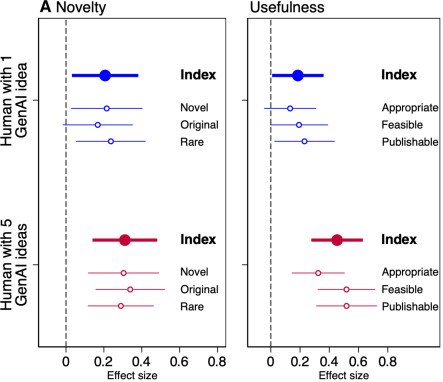
Doshi & Hauser (2024), Fig. 2A crop, CC BY 4.0. Dots: differences from human-only; bars: uncertainty.
MAIN FINDING
AI access raised average novelty and usefulness ratings. The two AI conditions also produced more similar stories.
LIMIT
A short writing task, not studio learning; similarity does not count cultural voices.
FOR YOUR DESIGN
Inspect the portfolio, not only its best item.
SD2112 · AI IN DESIGN · WEEK 11
11
THE ARGUMENT / G
What must a dataset explain?
QUESTION + APPROACH
Gebru and colleagues propose documentation to help people judge a dataset before using it. They refined questions over roughly two years using examples and feedback.
WHAT IS ANALYZED
They tried questions on face-image and movie-review datasets, then revised them using product-team, researcher and legal feedback.
ILLUSTRATIVE EXAMPLE / NOT STUDY WORDING
A review dataset may suit sentiment research. Does that make it suitable for judging a person? Purpose, collection context and missing information matter.
BASIS / NOT A PARTICIPANT EXPERIMENT
This is a documentation proposal with a development process, not a randomized harm-reduction trial. The examples expose unanswered questions, not a safety score.
SD2112 · AI IN DESIGN · WEEK 11
12
WHAT THE ARGUMENT SUPPORTS / G
Document the choice, including the unknowns.
THE PROPOSAL
Record purpose, contents, collection, uses and maintenance. Explain why a set fits this use; label what is unknown.
LIMIT
Documentation supports scrutiny. It does not establish consent, fairness or harmlessness.
FOR YOUR DESIGN / EXAMPLE
For our guide: museum facts are available; the fishing family has not been interviewed. Name who can fix errors.
SD2112 · AI IN DESIGN · WEEK 11
13
TOPIC 3 / 4
Agency and
authorship
Who decides? Who gets credit?
SD2112 · AI IN DESIGN · WEEK 11
14
AGENCY + AUTHORSHIP / ORIGINAL CONTRIBUTION MAP
Trace four different decisions.
01 / GENERATE
Tool proposes.
AI writes a draft from the source text.
→
02 / SELECT
Designer chooses.
Choose a draft that names its source.
→
03 / REVISE
Designer edits.
Check the facts and rewrite the text.
→
04 / AUTHORISE
Team releases.
A person approves it for visitors.
AI drafts. People choose, edit and publish. Keep a record of that work.
SD2112 · AI IN DESIGN · WEEK 11
15
FOUR DISTINCT QUESTIONS
Feeling, work, permission, law.
01 / FEEL
Does it feel mine?
A reported feeling is not a copyright certificate.
02 / CONTRIBUTE
Who did what?
Credit sources, selection, edits and review.
03 / PERMISSION
May we reuse it?
Check rights and consent for the material.
04 / PROTECTION
What is protected?
Human expression is a separate legal question.
SD2112 · AI IN DESIGN · WEEK 11
16
THE STUDY / N
What did designers describe?
WHAT THEY DID
28 U.S. participants discussed an AI image they had already made: 10 junior students, 10 senior students and 8 professionals. Interviews took 30-45 minutes in June-August 2024.
WHAT THEY COMPARED
The researchers compared themes across experience groups. Nobody was assigned to use or avoid AI; no skill test was run.
SOURCE ADAPTATION / FIG. 1(d), PDF 9
A source-described artifact began as a kayaker photograph, was transformed with AI, then manually colour-edited. What work would the final image hide?
WHAT THEY MEASURED
Interview transcripts were coded into themes about practice, values and ownership. These are reported experiences, not a score or a causal test of skill loss.
SD2112 · AI IN DESIGN · WEEK 11
17
THE RESULT / N
A participant view is not a legal rule.
WHAT DESIGNERS REPORTED
Juniors described shared authorship; seniors linked ownership to input/editing; professionals discussed developer responsibility.
LIMIT
Self-selected U.S. accounts do not establish legal rights or caused skill loss.
FOR YOUR DESIGN / EXAMPLE
Make contributions visible; test whether people can contest the choice.
SD2112 · AI IN DESIGN · WEEK 11
18
THE STUDY / J
Would you type more to avoid friction?
WHAT THEY DID
29 analyzed participants wrote story prompts using three interfaces. A second experiment repeated the task with 30 new participants and added AI suggestions.
WHAT THEY COMPARED
Normal submit versus hold-button or pump-slider for short prompts. Baseline first; time/motor order randomized.
ILLUSTRATIVE EXAMPLE / NOT STUDY WORDING
An instructor example: expand a brief story idea, or keep it short and spend effort submitting it. This is not a prompt-length copyright test.
WHAT THEY MEASURED
Prompt words were counted. Four self-reports about ownership, responsibility and connection were averaged on a 0-100 scale. A higher score means feeling more ownership.
SD2112 · AI IN DESIGN · WEEK 11
19
THE RESULT / J
More input can feel more yours.
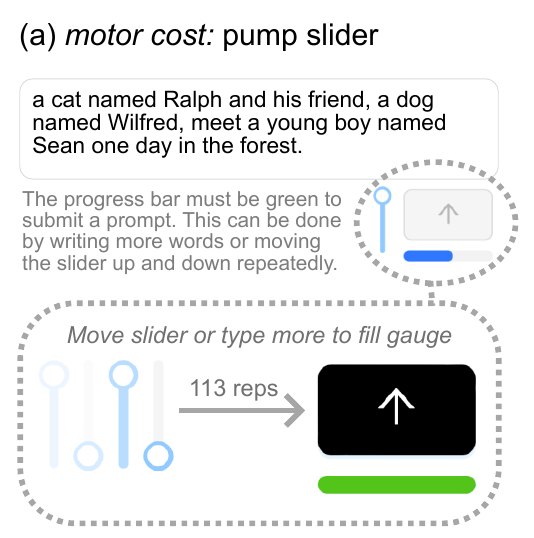
Joshi & Vogel (2026), Fig. 1(a) crop / v3, PDF 1. CC BY 4.0. Motor-cost example; (b)/(c) omitted. Full figure: source link.
MAIN FINDING
Time/motor: longer prompts, higher reported ownership. Suggestions added words, not a clear further ownership gain.
LIMIT
Baseline-first order and brief tasks limit inference. No legal rights were measured.
FOR YOUR DESIGN
Test contribution AND accessibility costs.
SD2112 · AI IN DESIGN · WEEK 11
20
THE ARGUMENT / U
Which human expression is protected?
QUESTION + APPROACH
The U.S. Copyright Office Part 2 report (January 2025) analyzes copyrightability using law, policy and responses to its public inquiry. It is not a participant experiment.
WHAT IS ANALYZED
It compares assistance, prompts, human expression and creative editing. Third-party reuse permission is a separate question.
ILLUSTRATIVE EXAMPLE / NOT STUDY WORDING
An instructor example: a designer arranges a poster and edits generated material. Ask separately what human expression is protectable and whether the inputs may be reused.
BASIS / NOT A PARTICIPANT EXPERIMENT
The basis is legal/policy analysis, not an ownership-feeling scale. Human contributions require case-by-case assessment. U.S. guidance, not Hong Kong legal advice.
SD2112 · AI IN DESIGN · WEEK 11
21
WHAT THE ARGUMENT SUPPORTS / U
Separate protection, permission and credit.
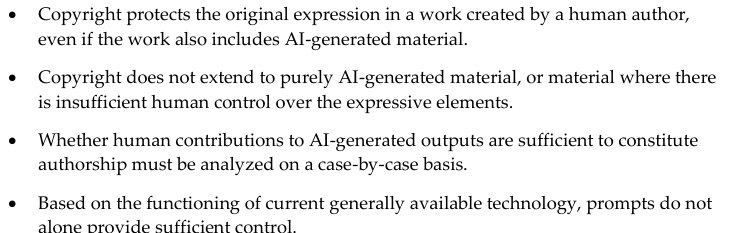
U.S. Copyright Office, Part 2 (Jan. 2025), Executive Summary, PDF 8 / iii. Federal text; not a figure.
THE OFFICE POSITION
Prompts alone: insufficient control with the tools analyzed. Human expression or creative editing may qualify case by case.
LIMIT
Not all generated parts are protected. No permission to copy others; not worldwide law.
FOR YOUR DESIGN
Unknown reuse permission? Hold or replace the material; seek advice.
SD2112 · AI IN DESIGN · WEEK 11
22
TOPIC 4 / 4
Responsibility
Who must respond when things go wrong?
SD2112 · AI IN DESIGN · WEEK 11
23
RESPONSIBILITY / DISTRIBUTED DOES NOT MEAN LOST
Name who can answer.
BEFORE / TEAM
Check the source.
Check the facts and permission to use the text.
→
DURING / GUIDE
Show the limits.
Say which story is missing.
→
AFTER / VISITOR
Raise an objection.
A fishing family says the story is wrong.
↓
WHO ACTS? / MUSEUM EDITOR
Check, correct or remove it.
←
Update the source and the guide.
↑
SD2112 · AI IN DESIGN · WEEK 11
24
SUNO / US COURT RECORD
A complaint is not a verdict.
PLAINTIFFS / JUN 2024
Complaint.
Universal, Sony + Warner allege unlicensed training copies.
→
DEFENDANT / AUG 2024
Answer.
Suno disputes liability; argues US fair use.
→
PARTY DEAL / NOV 2025
Settlement.
Warner + Suno announce a licensed-model partnership.
An allegation, a defence and a settlement are different kinds of evidence.
SD2112 · AI IN DESIGN · WEEK 11
25
SUNO / KEEP QUESTIONS APART
Four questions, not one ruling.
TRAINING
What recordings were copied?
The complaint alleges unlicensed training copies; legality is contested.
OUTPUT
Is a generated song protected?
Human contribution to a new song is a different copyrightability question.
SIMILARITY + CREDIT
Does it resemble a track?
Specific resemblance, attribution and payment are separate factual and ethical questions.
SD2112 · AI IN DESIGN · WEEK 11
26
CASE STATUS / VERIFIED BOUNDARY
Settlement is not universal clearance.
WARNER / VERIFIED 25 NOV 2025
Settled with Suno.
Their release reports a licensing partnership; it covers their dispute, not every label.
UNIVERSAL + SONY / STATUS BOUNDARY
Latest status unverified.
Reuters reported Universal ongoing on 5 June 2026; that is not a live status check. Sony was a plaintiff in 2024.
Design question: who records sources, permission, selection and credit for a public work?
SD2112 · AI IN DESIGN · WEEK 11
27
75-90 / RELATIVE CLASS TIME
Break.
15 minutes.
SD2112 · AI IN DESIGN · WEEK 11
28
AFTER THE BREAK / 15 MINUTES
Group project: ask me anything.
Submit your questions in ClassPoint; ask more than one if needed.
What is unclear about your idea, evidence or use of AI?
What is unclear about the poster, video or mediation brief?
What is the one thing your group is stuck on?
SD2112 · AI IN DESIGN · WEEK 11
29
ONE GROUP ACTIVITY / USE YOUR OWN PROJECT
Choose one topic. Improve one thing.
Choose ONE: mediation, curation and power, agency and authorship, or responsibility.
Look at ONE part of your project: a screen, an AI output, or a step in the experience.
Use your topic to spot one problem. Sketch or rewrite one change.
Be ready to explain: what is the problem, what will change, and why?
SD2112 · AI IN DESIGN · WEEK 11
30
CHOOSE ONE / THESE ARE FOUR OPTIONS
Use one question to guide your change.
01 / MEDIATION
What does AI change for the user?
What might the person notice, believe or do differently?
02 / CURATION AND POWER
What have you left out?
Which voices, sources or options are missing?
03 / AGENCY AND AUTHORSHIP
Who makes the important choice?
Can a person change the AI output? Whose work gets credit?
04 / RESPONSIBILITY
Who acts when it goes wrong?
How does a person report a problem? Who can fix it?
SD2112 · AI IN DESIGN · WEEK 11
31
WORKED EXAMPLE / CURATION AND POWER
One topic. One problem. One change.
OUR PROJECT
An AI museum guide.
It explains the old fishing boat to visitors.
THE PROBLEM
Only the museum story.
Visitors cannot hear from the people who worked on the boat.
OUR CHANGE
Add the family story.
Ask a fishing family, get permission, and let visitors choose either story. Until then, label it missing.
SD2112 · AI IN DESIGN · WEEK 11
32
ACTIVITY · APPLY ONE TOPIC / GROUP PROJECT
30 min
Make your change.
0-5 min: choose one topic and one part of your project.
5-15 min: agree on one problem and who it affects.
15-25 min: sketch or rewrite one change.
25-30 min: prepare a 60-second explanation.
SD2112 · AI IN DESIGN · WEEK 11
33
ACTIVITY · SAME ACTIVITY / CHECK YOUR IDEA WITH ANOTHER GROUP
20 min
Explain it. Hear a question. Improve it.
0-5 min: each group explains its problem and change in 60 seconds.
5-10 min: ask each other, "How would this change help the person using it?"
10-20 min: improve your sketch or wording.
SD2112 · AI IN DESIGN · WEEK 11
34
SHARE BACK / 10 MINUTES
Show the change, not a checklist.
One person per group: submit one text response in ClassPoint.
"We chose [topic]."
"In our project, the problem is ..."
"We changed ... because ..."
"We still need to find out ..."
SD2112 · AI IN DESIGN · WEEK 11
35
NEXT / YOUR EXISTING GROUP PROJECT
Keep the change. Keep the question.
Use the improvement in your A0 poster, 3-5 minute video or one-page mediation brief.
Group project: 40% of the course. Follow current Canvas milestones.
Week 12: when should we rely on AI, and who can challenge it?
Week 13: quiz + posters.
SD2112 · AI IN DESIGN · WEEK 11
36
READ THE FIGURE / D
Similar to what? Read the axis.
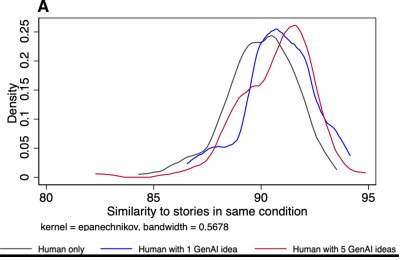
Fig. 4A, top: x = embedding similarity (0-100); y = density, not people. Black: no AI; blue: one idea; red: five. Further right = more similar stories.
Doshi & Hauser / Science Advances 2024 / Fig. 4A / top-panel crop / CC BY 4.0
SD2112 · AI IN DESIGN · WEEK 11
37
OPTIONAL REFERENCES / NOT PRE-READING
Sources behind today's questions.
Verbeek / Beyond Interaction / 2015
Doshi & Hauser / Science Advances 2024
Gebru et al. / Datasheets for Datasets / 2021
SD2112 · AI IN DESIGN · WEEK 11
38
SD2112 / WEEK 11
Who chooses? Who gets credit? Who is responsible?
NEWS / 12 NOVEMBER 2026 / US MARKET CLOSE
NVIDIA
Share price
NASDAQ
Stock index
AMD
Share price
BROADCOM
Share price
One trading day. Different directions. Not proof that all AI businesses are collapsing.
NEWS / NVIDIA ANNOUNCEMENT / 12 NOVEMBER 2026
WHAT CHANGED
Huang resigned.
He left the president, CEO and board roles, effective immediately.
WHO LEADS NOW
Colette Kress.
The CFO becomes interim CEO while also remaining CFO.
WHAT IS NEXT
A successor search.
The board will consider internal and external candidates.
The announcement says resignation, not retirement. Future retirement plans are not confirmed.
OPENING QUESTION / THINK, THEN DISCUSS
TOPIC 1 / 4
HOW DOES AI SHAPE WHAT WE UNDERSTAND?
FICTIONAL EXAMPLE / AN AI MUSEUM GUIDE
MUSEUM
Facts about the boat.
An old fishing boat is on display. The museum label says when it was built.
FISHING FAMILY
Life on the boat.
The family could explain what it was like to work on the boat.
IF NO ONE HAS ASKED
Say what is missing.
The guide should say the family has not been interviewed. It must not invent their story.
MEDIATION / VERBEEK 2015
01 / SOURCE
The museum gives facts.
The label says when the fishing boat was built.
02 / TOOL FRAMING
The guide summarises.
It tells the museum story, but leaves out the fishing family.
03 / VISITOR
The visitor reads one story.
They may learn when it was built, but miss what life on the boat was like.
The guide shapes how we understand the boat. It does not just pass on facts.
TOPIC 2 / 4
WHO CHOOSES WHAT WE SEE?
CURATION / CHOICE HAS POWER
INCLUDED / VISIBLE
The museum story.
Facts about the boat are easy to find. The team puts them first.
EDITORIAL CHOICE
What appears first?
The team decides which sources and stories the guide uses.
EXCLUDED / MISSING
The family story.
If no one has asked the fishing family, say so. Do not invent their story.
Choosing what to show also means choosing what people will not see.
THE STUDY / D
WHAT THEY DID
293 UK writers produced an eight-sentence story for young readers. Random assignment: no AI ideas, access to one, or up to five GPT-4 starting ideas.
WHAT THEY COMPARED
Writers wrote their own story. 600 separate evaluators each rated six stories before learning about AI access.
SOURCE ADAPTATION / METHODS
One assigned topic was an adventure on the open seas. AI supplied a starting idea, not an iterative conversation or the finished eight sentences.
WHAT THEY MEASURED
Readers rated novelty and audience/publishing usefulness from 1 (not at all) to 9 (extremely). Researchers also compared story embeddings: similarity from 0 to 100.
THE RESULT / D
Doshi & Hauser (2024), Fig. 2A crop, CC BY 4.0. Dots: differences from human-only; bars: uncertainty.
MAIN FINDING
AI access raised average novelty and usefulness ratings. The two AI conditions also produced more similar stories.
LIMIT
A short writing task, not studio learning; similarity does not count cultural voices.
FOR YOUR DESIGN
Inspect the portfolio, not only its best item.
THE ARGUMENT / G
QUESTION + APPROACH
Gebru and colleagues propose documentation to help people judge a dataset before using it. They refined questions over roughly two years using examples and feedback.
WHAT IS ANALYZED
They tried questions on face-image and movie-review datasets, then revised them using product-team, researcher and legal feedback.
ILLUSTRATIVE EXAMPLE / NOT STUDY WORDING
A review dataset may suit sentiment research. Does that make it suitable for judging a person? Purpose, collection context and missing information matter.
BASIS / NOT A PARTICIPANT EXPERIMENT
This is a documentation proposal with a development process, not a randomized harm-reduction trial. The examples expose unanswered questions, not a safety score.
WHAT THE ARGUMENT SUPPORTS / G
THE PROPOSAL
LIMIT
Documentation supports scrutiny. It does not establish consent, fairness or harmlessness.
FOR YOUR DESIGN / EXAMPLE
For our guide: museum facts are available; the fishing family has not been interviewed. Name who can fix errors.
TOPIC 3 / 4
WHO DECIDES? WHO GETS CREDIT?
AGENCY + AUTHORSHIP / ORIGINAL CONTRIBUTION MAP
01 / GENERATE
Tool proposes.
AI writes a draft from the source text.
02 / SELECT
Designer chooses.
Choose a draft that names its source.
03 / REVISE
Designer edits.
Check the facts and rewrite the text.
04 / AUTHORISE
Team releases.
A person approves it for visitors.
AI drafts. People choose, edit and publish. Keep a record of that work.
FOUR DISTINCT QUESTIONS
01 / FEEL
Does it feel mine?
A reported feeling is not a copyright certificate.
02 / CONTRIBUTE
Who did what?
Credit sources, selection, edits and review.
03 / PERMISSION
May we reuse it?
Check rights and consent for the material.
04 / PROTECTION
What is protected?
Human expression is a separate legal question.
THE STUDY / N
WHAT THEY DID
28 U.S. participants discussed an AI image they had already made: 10 junior students, 10 senior students and 8 professionals. Interviews took 30-45 minutes in June-August 2024.
WHAT THEY COMPARED
The researchers compared themes across experience groups. Nobody was assigned to use or avoid AI; no skill test was run.
SOURCE ADAPTATION / FIG. 1(d), PDF 9
A source-described artifact began as a kayaker photograph, was transformed with AI, then manually colour-edited. What work would the final image hide?
WHAT THEY MEASURED
Interview transcripts were coded into themes about practice, values and ownership. These are reported experiences, not a score or a causal test of skill loss.
THE RESULT / N
WHAT DESIGNERS REPORTED
LIMIT
Self-selected U.S. accounts do not establish legal rights or caused skill loss.
FOR YOUR DESIGN / EXAMPLE
Make contributions visible; test whether people can contest the choice.
THE STUDY / J
WHAT THEY DID
29 analyzed participants wrote story prompts using three interfaces. A second experiment repeated the task with 30 new participants and added AI suggestions.
WHAT THEY COMPARED
Normal submit versus hold-button or pump-slider for short prompts. Baseline first; time/motor order randomized.
ILLUSTRATIVE EXAMPLE / NOT STUDY WORDING
An instructor example: expand a brief story idea, or keep it short and spend effort submitting it. This is not a prompt-length copyright test.
WHAT THEY MEASURED
Prompt words were counted. Four self-reports about ownership, responsibility and connection were averaged on a 0-100 scale. A higher score means feeling more ownership.
THE RESULT / J
Joshi & Vogel (2026), Fig. 1(a) crop / v3, PDF 1. CC BY 4.0. Motor-cost example; (b)/(c) omitted. Full figure: source link.
MAIN FINDING
Time/motor: longer prompts, higher reported ownership. Suggestions added words, not a clear further ownership gain.
LIMIT
Baseline-first order and brief tasks limit inference. No legal rights were measured.
FOR YOUR DESIGN
Test contribution AND accessibility costs.
THE ARGUMENT / U
QUESTION + APPROACH
The U.S. Copyright Office Part 2 report (January 2025) analyzes copyrightability using law, policy and responses to its public inquiry. It is not a participant experiment.
WHAT IS ANALYZED
It compares assistance, prompts, human expression and creative editing. Third-party reuse permission is a separate question.
ILLUSTRATIVE EXAMPLE / NOT STUDY WORDING
An instructor example: a designer arranges a poster and edits generated material. Ask separately what human expression is protectable and whether the inputs may be reused.
BASIS / NOT A PARTICIPANT EXPERIMENT
The basis is legal/policy analysis, not an ownership-feeling scale. Human contributions require case-by-case assessment. U.S. guidance, not Hong Kong legal advice.
WHAT THE ARGUMENT SUPPORTS / U
U.S. Copyright Office, Part 2 (Jan. 2025), Executive Summary, PDF 8 / iii. Federal text; not a figure.
THE OFFICE POSITION
Prompts alone: insufficient control with the tools analyzed. Human expression or creative editing may qualify case by case.
LIMIT
Not all generated parts are protected. No permission to copy others; not worldwide law.
FOR YOUR DESIGN
Unknown reuse permission? Hold or replace the material; seek advice.
TOPIC 4 / 4
WHO MUST RESPOND WHEN THINGS GO WRONG?
RESPONSIBILITY / DISTRIBUTED DOES NOT MEAN LOST
BEFORE / TEAM
Check the source.
Check the facts and permission to use the text.
DURING / GUIDE
Show the limits.
Say which story is missing.
AFTER / VISITOR
Raise an objection.
A fishing family says the story is wrong.
WHO ACTS? / MUSEUM EDITOR
Check, correct or remove it.
Update the source and the guide.
SUNO / US COURT RECORD
PLAINTIFFS / JUN 2024
Complaint.
Universal, Sony + Warner allege unlicensed training copies.
DEFENDANT / AUG 2024
Answer.
Suno disputes liability; argues US fair use.
PARTY DEAL / NOV 2025
Settlement.
Warner + Suno announce a licensed-model partnership.
An allegation, a defence and a settlement are different kinds of evidence.
SUNO / KEEP QUESTIONS APART
TRAINING
What recordings were copied?
The complaint alleges unlicensed training copies; legality is contested.
OUTPUT
Is a generated song protected?
Human contribution to a new song is a different copyrightability question.
SIMILARITY + CREDIT
Does it resemble a track?
Specific resemblance, attribution and payment are separate factual and ethical questions.
Complaint / alleged examples / U.S. Copyright Office / Part 2 / January 2025
CASE STATUS / VERIFIED BOUNDARY
WARNER / VERIFIED 25 NOV 2025
Settled with Suno.
Their release reports a licensing partnership; it covers their dispute, not every label.
UNIVERSAL + SONY / STATUS BOUNDARY
Latest status unverified.
Reuters reported Universal ongoing on 5 June 2026; that is not a live status check. Sony was a plaintiff in 2024.
Design question: who records sources, permission, selection and credit for a public work?
75-90 / RELATIVE CLASS TIME
AFTER THE BREAK / 15 MINUTES
Submit your questions in ClassPoint; ask more than one if needed.
What is unclear about your idea, evidence or use of AI?
What is unclear about the poster, video or mediation brief?
What is the one thing your group is stuck on?
ClassPoint · short answer — answer on the projector
ONE GROUP ACTIVITY / USE YOUR OWN PROJECT
Choose ONE: mediation, curation and power, agency and authorship, or responsibility.
Look at ONE part of your project: a screen, an AI output, or a step in the experience.
Use your topic to spot one problem. Sketch or rewrite one change.
Be ready to explain: what is the problem, what will change, and why?
CHOOSE ONE / THESE ARE FOUR OPTIONS
01 / MEDIATION
What does AI change for the user?
What might the person notice, believe or do differently?
02 / CURATION AND POWER
What have you left out?
Which voices, sources or options are missing?
03 / AGENCY AND AUTHORSHIP
Who makes the important choice?
Can a person change the AI output? Whose work gets credit?
04 / RESPONSIBILITY
Who acts when it goes wrong?
How does a person report a problem? Who can fix it?
WORKED EXAMPLE / CURATION AND POWER
OUR PROJECT
An AI museum guide.
It explains the old fishing boat to visitors.
THE PROBLEM
Only the museum story.
Visitors cannot hear from the people who worked on the boat.
OUR CHANGE
Add the family story.
Ask a fishing family, get permission, and let visitors choose either story. Until then, label it missing.
ACTIVITY · APPLY ONE TOPIC / GROUP PROJECT
0-5 min: choose one topic and one part of your project.
5-15 min: agree on one problem and who it affects.
15-25 min: sketch or rewrite one change.
25-30 min: prepare a 60-second explanation.
ACTIVITY · SAME ACTIVITY / CHECK YOUR IDEA WITH ANOTHER GROUP
0-5 min: each group explains its problem and change in 60 seconds.
5-10 min: ask each other, "How would this change help the person using it?"
10-20 min: improve your sketch or wording.
SHARE BACK / 10 MINUTES
One person per group: submit one text response in ClassPoint.
"We chose [topic]."
"In our project, the problem is ..."
"We changed ... because ..."
"We still need to find out ..."
ClassPoint · short answer — answer on the projector
NEXT / YOUR EXISTING GROUP PROJECT
Use the improvement in your A0 poster, 3-5 minute video or one-page mediation brief.
Group project: 40% of the course. Follow current Canvas milestones.
Week 12: when should we rely on AI, and who can challenge it?
Week 13: quiz + posters.
READ THE FIGURE / D
Fig. 4A, top: x = embedding similarity (0-100); y = density, not people. Black: no AI; blue: one idea; red: five. Further right = more similar stories.
Doshi & Hauser / Science Advances 2024 / Fig. 4A / top-panel crop / CC BY 4.0
OPTIONAL REFERENCES / NOT PRE-READING
Verbeek / Beyond Interaction / 2015
Doshi & Hauser / Science Advances 2024
Gebru et al. / Datasheets for Datasets / 2021